Territory Claim Maze Challenge
Reviews
Territory Claim Maze Challenge successfully blends retro arcade navigation with strategic territory control. The core loop of drawing lines to enclose areas while avoiding ghosts is both simple and deep. The gradual increase in ghost count and maze complexity ensures a steady challenge without sudden spikes. The cheerful visuals and lack of time pressure make it a relaxing yet mentally stimulating experience. It is an excellent choice for puzzle fans looking for a fresh take on maze games.
Description
Core Territory Mechanics
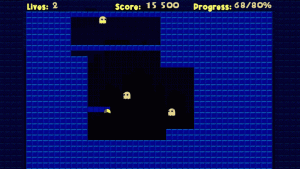
Players control a small character moving through a grid-based maze. The primary action involves drawing lines behind the character to enclose empty sections of the maze. Once an area is fully surrounded, it becomes claimed territory, adding to the player's score. This mechanic requires careful planning because the line remains vulnerable until the enclosure is complete. Ghosts patrol the maze and can intercept the player, forcing them to restart the line if caught. The balance between expanding territory and avoiding capture creates a tense, engaging loop.
Ghost Behavior & Evasion
Ghosts in this game follow predictable patterns but increase in number as levels progress. They do not chase aggressively; instead, they roam along set paths, which allows observant players to anticipate their movements. When a ghost touches the player's drawn line, the line is erased, and the player must begin again. This design rewards patience and pattern recognition. Players can use fruits that appear occasionally to stun nearby ghosts temporarily, providing a safe window to claim more territory. Mastering ghost patterns is essential for higher scores.
Progression & Difficulty Curve
Each new level introduces more ghosts and tighter maze layouts, reducing the safe spaces available for movement. Early levels serve as tutorials, with open areas and few ghosts. Later stages require players to claim territory in narrow corridors while multiple ghosts patrol nearby. The difficulty increases gradually, ensuring that players develop skills at a comfortable pace. There is no time limit, so players can pause and plan their route before moving. This design makes the game accessible to newcomers while offering depth for experienced puzzle enthusiasts.
Visual Style & Audio Atmosphere
The game uses bright, colorful graphics with a clean, cartoon-like aesthetic. Characters and ghosts are designed with simple shapes and friendly expressions, reinforcing the non-violent theme. The maze walls are clearly defined, and claimed territory changes color to provide immediate visual feedback. Background music is upbeat and loop-based, matching the retro arcade feel. Sound effects are minimal but clear, such as a chime when territory is claimed or a warning tone when a ghost approaches. The overall presentation is cheerful and unintimidating.
Control Scheme & Accessibility
Controls are straightforward: arrow keys or on-screen directional buttons move the character through the maze. There are no complex combos or special moves to learn. The game supports both keyboard and touch input, making it playable on various devices. The interface is minimal, with score and level displayed at the top. Menus are simple and load quickly. This simplicity allows players to focus entirely on the puzzle mechanics without distraction. The game also includes an option to adjust sound volume and toggle music independently.



Comments
0 comments